
Commercial cabling for the environments where you operate.
Structured cabling, fiber optics, CCTV and access control installed specifically for the operational realities of your facility — not a one-size-fits-all approach applied to every commercial environment the same way.
- Offices, warehouses, healthcare, retail, hospitality and manufacturing
- Scope planned around how your facility actually operates day to day
- Active-facility coordination — phased, after-hours, occupied-site work
- Repeatable standards for single sites and growing multi-location portfolios
Every commercial environment has a different infrastructure problem
A corporate office requires structured workstation drops, conference room AV connectivity and organized MDF/IDF rooms that support constant moves and reconfigurations. A warehouse requires high-ceiling wireless AP cabling, loading dock CCTV infrastructure and fiber backbones that span 100,000+ square feet. A healthcare clinic requires tightly coordinated cabling in active patient care spaces where downtime is not an option.
These are not the same problem. The device density is different, the pathway challenges are different, the security requirements are different, the operational continuity constraints are different and the documentation expectations are different. Applying a single generic cabling model across all three of these environments creates friction at every stage — from scoping through installation to the long-term support relationship afterward.
Cablify approaches every commercial project from the specific operational reality of the facility type — planning scope, scheduling, delivery and documentation around how the environment actually works, not how a generic commercial installer assumes it does. Explore the seven commercial environments below to see how the service model adapts.
Dense workstation drops, conference room AV, AP cabling, organized MDF/IDF rooms, occupied-space phasing
High-ceiling AP runs, fiber backbones, loading dock CCTV, access control, operational technology networks
Active-care coordination, secure wireless, clinical device connectivity, after-hours scheduling, strict documentation
Repeatable store standards, POS connectivity, CCTV, access control, fast turnover for new openings & remodels
Fiber backbones across production areas, OT network support, security coverage, EMI-resistant infrastructure
Corporate Offices & Headquarters
Corporate office network cabling environments require structured copper infrastructure that supports daily operations, conference room technology, wireless access points, VoIP phones, security systems and organized MDF/IDF rooms — while remaining flexible enough to support constant floor reconfigurations, department moves and growing headcount without requiring full rework.
Modern offices are installed with Cat6A cabling at workstation drops to support 10-Gigabit performance and PoE++ for high-power wireless access points. Conference rooms require dedicated drops for displays, video conferencing codecs, AV equipment and shared device connectivity. MDF and IDF rooms are organized with clean patch panels, cable management and documentation that IT teams can actually read and maintain after turnover.
2+ Cat6A drops per position, VoIP phone drops, labeled patch panels
Displays, VC codecs, AV equipment, AP drops and floor boxes
Cat6A ceiling drops, PoE++ for enterprise APs, coordinated with wireless vendor
Organized racks, cable management, labeled panels and as-built docs
- Structured cabling for desks, meeting rooms and support spaces
- Network cabling and wireless AP infrastructure planning
- Occupied-space phasing and after-hours installation coordination

Warehouses & Logistics Facilities
Warehouse network cabling is fundamentally different from office cabling. Distribution centers, fulfillment floors and logistics operations present pathway challenges that don't exist in a finished office building — high ceilings requiring 40+ foot cable runs to AP mounting positions, conduit routing through active operational areas, and CCTV coverage across loading docks and operational zones that must be designed around real freight movement patterns.
Modern logistics facilities require fiber backbone infrastructure between equipment rooms to support the wireless access points, security cameras and barcode scanning systems that operational efficiency depends on. The infrastructure must remain operational during phased installation — shipping, receiving and inventory operations cannot pause for a cabling project.
Cat6A drops to access points 20–40 feet high, plenum cable in rafter spaces
OM4 fiber between equipment rooms, server closets and network distribution points
Loading dock, gate and operational zone camera coverage with access points
Barcode scanner drops, operational technology devices, dispatch connectivity
- Network cabling and high-ceiling wireless AP infrastructure
- Low voltage cabling for CCTV and access control on docks and gates
- Fiber optic cabling for inter-room backbone connectivity

Healthcare & Medical Facilities
Healthcare cabling infrastructure demands a level of project coordination that most commercial environments don't require. Clinical spaces, patient care areas and active treatment rooms cannot be taken offline during installation — which means every phase of work must be scheduled, sequenced and executed around clinical operations that cannot pause for a network upgrade.
The infrastructure itself must support clinical workstations, patient management platforms, medical imaging data pathways, secure wireless coverage across patient areas, and security systems that include both CCTV surveillance and access control for restricted clinical zones. Organized structured cabling with clean labeling and as-built documentation is not optional in healthcare — it directly affects how quickly IT teams can respond to connectivity issues that impact patient care.
Cat6A drops for clinical devices, workstations and exam room connectivity
AP cabling for secure wireless coverage across patient, admin and support areas
Phased work around clinical operations, after-hours and weekend scheduling
Restricted zone access control for medication rooms, data rooms and clinical spaces
- Structured cabling for clinical workstations, admin and device connectivity
- Coordinated low-voltage and security system installation in active care spaces
- Access control systems for restricted clinical and data zones
Retail & Franchise Networks
Retail network infrastructure must support point-of-sale systems, digital signage, wireless coverage, security cameras, door access control and back-office connectivity — and it must do all of this in a fast-turnover environment where new store openings, remodels and refreshes happen on tight timelines where cost overruns and scheduling delays have direct business impact.
Multi-location retail operators and franchise networks benefit most from a service model built around repeatable standards — the same cabling layout, the same labeling convention, the same documentation template applied at every location. This creates a portfolio where IT teams can support any store using the same reference system, and where each new opening or remodel follows a consistent playbook that doesn't fragment across disconnected installation approaches.
Data cabling for point-of-sale terminals, printers and customer-facing devices
Security camera pathways, backroom NVR infrastructure, loss prevention scope
Same cabling layout, labeling and documentation across every location
New opening, remodel and refresh timelines coordinated around store operations
- POS, back-office and customer-facing data cabling
- CCTV infrastructure and access control systems
- Repeatable standards for regional rollouts and franchise expansion
Hospitality & Mixed-Use Properties
Hospitality properties and mixed-use commercial buildings present a unique infrastructure challenge — multiple distinct user populations (guests, staff, back-of-house operations, tenants) with different connectivity needs, security requirements and technology expectations, all sharing the same building infrastructure and all expecting their systems to stay operational while cabling work continues around them.
These projects typically involve structured cabling for administrative and back-of-house areas, wireless coverage planning across guest-facing spaces, fiber backbone infrastructure between technical rooms and broader low-voltage coordination for communications, surveillance and property management systems. The strongest hospitality installations are organized around long-term supportability — systems need to remain serviceable throughout the full operating life of the property.
Separate connectivity standards for guest-facing and back-of-house spaces
Backbone routing between technical rooms, MDF and distributed IDF closets
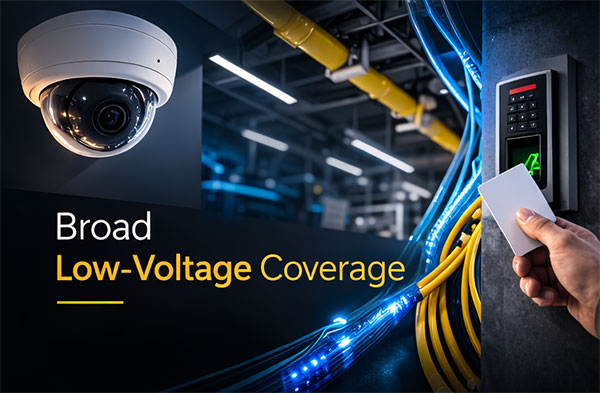
Surveillance, access control, paging and communications system coordination
Phased work and coordination around ongoing property operations
- Low voltage cabling for communications, surveillance and security infrastructure
- Fiber infrastructure between technical rooms and distributed network closets
- Network cabling for guest, staff and operational zones
Manufacturing & Industrial Environments
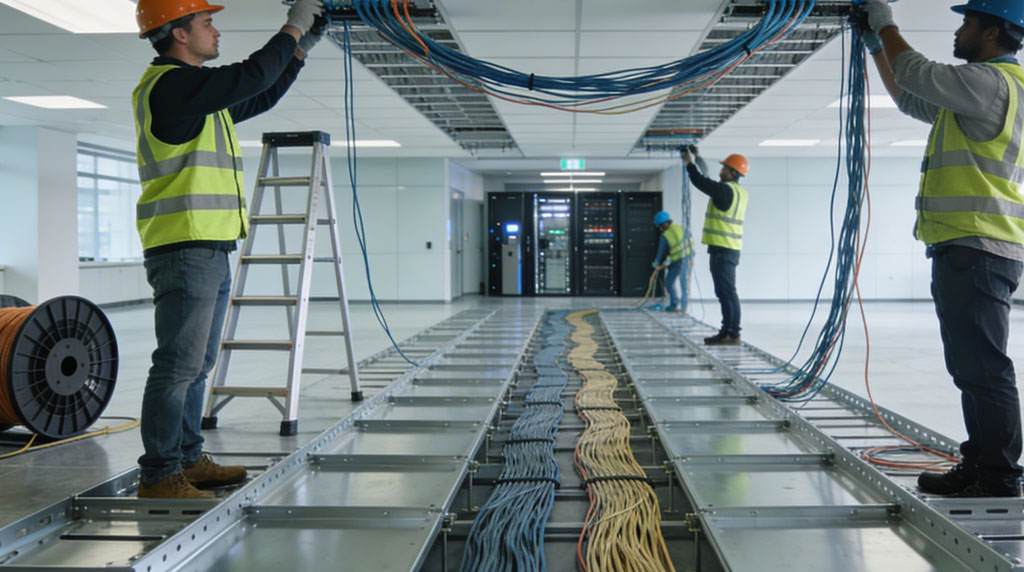
Manufacturing and industrial facilities present infrastructure challenges that commercial office experience alone doesn't prepare for — electromagnetic interference from motors and industrial equipment, harsh environmental conditions, complex pathway routing through active production areas, and operational technology (OT) networks that run independently from IT infrastructure but share the same physical building.
Fiber optic cabling is often the right choice for runs across production floors and between building areas in manufacturing environments — fiber's immunity to electromagnetic interference from industrial equipment makes it more reliable than copper in environments where motors, variable frequency drives and other industrial systems create electrical noise. Structured cabling supports office and control room environments within the facility, while security camera and access control infrastructure protects restricted production zones and material handling areas.
EMI-immune fiber runs across production floors and between building areas
Cat6A for office areas, control rooms and equipment management systems
CCTV coverage and access control for restricted production and storage zones
Installation sequenced around production schedules and operational requirements
- Industrial network cabling and structured copper support
- Fiber backbone infrastructure between production and technical areas
- Security camera coverage and access control for restricted zones

Technical Rooms & Data Infrastructure Spaces
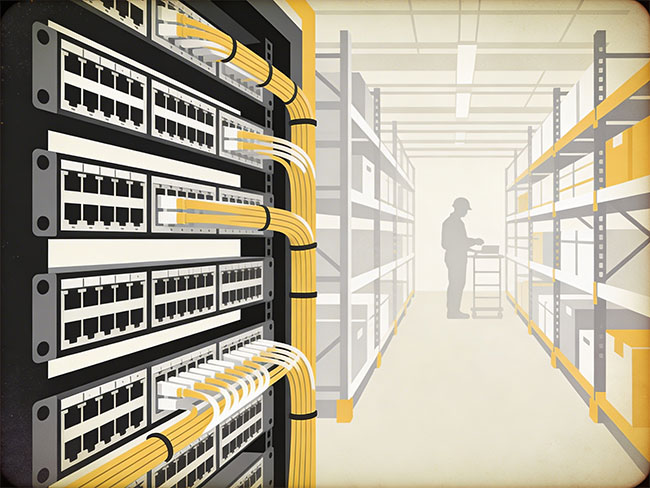
Server rooms, IDF closets, MDF rooms and technical data spaces are where the long-term supportability of a building's entire cabling infrastructure is won or lost. An organized, labeled, documented network room is one that IT teams can manage, expand and troubleshoot without guesswork. A disorganized room with unlabeled cables, mismatched patch panels and no documentation creates friction in every support event for the entire life of the facility.
Technical room projects range from organized greenfield buildouts in new construction to cleanup and reorganization projects in existing facilities where infrastructure has accumulated without consistent standards. Work typically includes cabinet cleanup, fiber termination, patch-panel reorganization, labeling improvements, backbone routing and structured upgrades that bring the environment up to a standard that IT and facilities teams can actually manage. Data center cabling discipline — organized racks, clean fiber management, consistent labeling and complete documentation — is the approach applied to every technical space.
Cabinet installation, mounting, cable management and organized patch panel layout
Fiber enclosure installation, LC/SC termination and OTDR testing
Port labeling, patch schedules and as-built documentation for every room
Legacy infrastructure cleanup, re-termination and standards upgrade
- Rack layouts, patch panel organization and cabinet cable management
- Fiber backbone connections and technical room infrastructure
- Data center cabling, structured cabling and documentation delivery
Which services apply across each commercial environment
Most commercial environments use multiple services under the same project scope — structured cabling alongside fiber backbone, CCTV coordinated with access control. This matrix shows the typical service mix by industry.
| Industry | Structured cabling |
Fiber optic |
Network cabling |
Low voltage |
CCTV | Access control |
|---|---|---|---|---|---|---|
| Corporate offices | PRIMARY | ✓ | ✓ | ✓ | ✓ | ✓ |
| Warehouses & logistics | ✓ | PRIMARY | PRIMARY | ✓ | PRIMARY | ✓ |
| Healthcare & clinical | PRIMARY | ✓ | ✓ | PRIMARY | ✓ | PRIMARY |
| Retail & franchise | ✓ | — | ✓ | ✓ | PRIMARY | PRIMARY |
| Hospitality & mixed-use | ✓ | ✓ | ✓ | PRIMARY | ✓ | ✓ |
| Manufacturing & industrial | ✓ | PRIMARY | ✓ | ✓ | PRIMARY | PRIMARY |
| Technical rooms & data spaces | PRIMARY | PRIMARY | ✓ | — | — | — |
PRIMARY = typically the lead service scope in this industry. ✓ = commonly included under same project scope. — = less common for this environment.
One cabling standard across every location in your portfolio
Multi-site operators, growing franchises and regional businesses benefit from a delivery model that applies consistent cabling standards, labeling conventions and documentation templates across every facility — so each new location inherits a supportable environment and IT teams can manage any site using the same reference system.
The same cable standard, drop layout, labeling convention and documentation template applied at every location — regardless of city, building type or project timeline.
Every site delivers the same documentation format — so IT and facilities teams can support any location using the same port maps, labeling system and infrastructure records.
Multi-city rollouts with overlapping timelines coordinated across markets — consistent project delivery whether the program spans 3 locations or 30.

Questions about industry-specific commercial cabling
Answers that help buyers understand how commercial cabling scope, scheduling and delivery approach changes across different facility types.
Which industries benefit most from commercial cabling upgrades?
Corporate offices, warehouses, healthcare facilities, retail networks, hospitality properties, manufacturing environments and data rooms all benefit significantly — with each industry having distinct requirements around device density, pathway challenges, security expectations and operational continuity.
Do different industries need different cabling strategies?
Yes. A warehouse needs high-ceiling AP cabling, fiber backbones and loading dock CCTV. An office needs structured workstation drops, conference room connectivity and organized patch panels. A healthcare clinic needs tightly coordinated work in active patient care areas. The service mix and delivery approach should match the environment.
Can Cablify work in active facilities during installation?
Yes. Many projects take place in occupied offices, healthcare facilities, warehouses and retail environments where operations cannot pause. Work can be phased by floor, zone or department, scheduled after hours, or coordinated around business operations to minimize disruption throughout the project.
Can one cabling standard support multiple locations?
Yes. Multi-location businesses benefit most from repeatable cabling standards, consistent labeling conventions, network room layouts and low-voltage coordination that scale from one site to many — keeping infrastructure consistent and supportable across the full portfolio.
Tell us the facility type, city and scope — we'll take it from there.
Share the environment, market, service needs and timeline so the conversation can move toward a practical commercial recommendation and scope review.
Request a Commercial Cabling Quote
Whether you're upgrading one facility or rolling out across a multi-location portfolio, share the details and the Cablify team will follow up within one business day.
Facility type (office, warehouse, healthcare, retail, etc.), city, services needed, number of locations, timeline and whether the site is active during installation.
INDUSTRIES: Offices · Warehouses · Healthcare · Retail · Hospitality · Manufacturing · Data rooms