
Low voltage cabling that connects network, security & building systems.
Commercial low voltage cabling for CCTV cameras, access control systems, wireless AP infrastructure, AV systems and connected building technology — installed and coordinated alongside structured network cabling across the full project scope.
- CCTV camera cabling — pathways, backhaul runs and NVR room infrastructure
- Access control cabling — readers, controllers, locks and door-related hardware
- Wireless AP cabling coordinated alongside network and security scope
- AV, paging, intercom and specialty building system support
The infrastructure layer beneath the network — connecting security, building systems and specialty devices
Low voltage cabling covers the physical wiring infrastructure for any system that operates below 50 volts — which in a commercial building includes data and network cabling, security camera (CCTV) systems, access control readers and controllers, wireless access points, AV systems, paging, intercom and other connected building technology.
The term "low voltage" is commonly used by facilities managers and operations teams when a project involves multiple building systems under one scope — not just network drops. A commercial renovation that includes new workstation cabling, CCTV camera coverage, door access control and wireless AP infrastructure is a low voltage project, because all of those systems share pathways, closet space and project coordination requirements.
Cablify installs commercial low voltage systems alongside structured cabling and network cabling — treating CCTV, access control, wireless AP cabling and specialty systems as part of the same coordinated infrastructure project rather than isolated one-off installations that create pathway conflicts and documentation gaps. Every project closes with labeled, documented, tested infrastructure regardless of which systems were included.
Camera drop pathways, backhaul cable runs, NVR/DVR room infrastructure and PoE switch connections
Door reader wiring, controller cabling, lock power runs and panel connections for single-door or multi-zone systems
Cat6A ceiling drops with PoE for enterprise access points — coordinated with wireless vendor placement plans
Display cabling, audio distribution, paging speakers, intercoms and conference room infrastructure
Cat6A workstation drops, patch panels, MDF/IDF organization — coordinated with all other low voltage systems
Commercial low voltage cabling — system by system
Each low voltage system has specific cabling requirements, pathway needs and termination standards. Here's a breakdown of what each system includes and how it connects back to the broader building infrastructure.
CCTV & Security Camera Cabling
Commercial CCTV camera cabling routes Cat6 or Cat6A cable from each camera mounting location back to the NVR/DVR recording equipment — typically in a dedicated server room, IDF closet or security rack. Cameras are powered via PoE (Power over Ethernet) from the same cable that carries the video signal, which means the cabling quality, run distance and PoE standard all affect image reliability.
- Camera drop cabling to each mounting location — ceiling, wall or column-mount
- PoE Cat6 or Cat6A runs from camera to nearest PoE switch
- NVR/DVR room infrastructure — rack, patch panel and cable management
- Conduit and pathway coordination for outdoor and exposed-ceiling locations
- PTZ cameras require Cat6A for PoE+ or PoE++ power delivery
Access Control System Cabling
Access control cabling connects card readers, keypads and credential devices at doors back to access control panels or controllers — which then connect to the access control software via the network. The cabling for each door typically includes a reader cable (from the door to the panel), a door position sensor cable, and a lock power cable (for electric strikes or magnetic locks).
- Reader-to-panel cabling for card, fob and biometric credential devices
- Door position sensor (DPS) and request-to-exit (REX) device cabling
- Electric strike and magnetic lock power wiring
- Access control panel installation and cable termination
- Network connection from access control panel to building network
Wireless Access Point Cabling
Every wireless access point requires a dedicated Cat6A Ethernet drop — this is low voltage cabling, not a separate trade. Enterprise wireless APs from Cisco Meraki, Aruba, Ubiquiti and similar vendors are powered via PoE++ from the same cable that carries network traffic, which means the run must be Cat6A to support both 10G performance and high-power PoE at the full 100-meter horizontal distance.
- Cat6A ceiling drops to every AP mounting location
- Plenum-rated cable above drop ceilings
- Junction boxes and support hardware for ceiling-mount APs
- Coordinated with wireless vendor AP placement plans before cable is pulled
- PoE++ capable to support tri-radio enterprise APs at full power
AV, Paging & Specialty Systems
AV systems, paging, intercom and specialty building technology all require structured cabling infrastructure that shares pathways with network and security systems. Conference room AV cabling is increasingly Cat6A-based as display systems, video conferencing codecs and room controllers connect via HDMI over Cat6A extenders or direct Ethernet connections. Paging speakers require dedicated audio cabling from the amplifier to each speaker zone.
- Conference room display, codec and AV equipment cabling
- Paging amplifier to speaker zone cabling
- Intercom station and master station cabling
- Digital signage display cabling in retail, hospitality and commercial spaces
- Pathway coordination with other low voltage and network systems
Low voltage systems share the same pathways — planning them separately creates problems
When CCTV cameras, access control readers, wireless APs and network drops are each planned independently by different contractors, the result is a facility where the same ceiling pathways get opened and closed multiple times, conduit fill limits get exceeded, and no single person has a complete view of what's installed where.
CCTV, access control, AP drops and network cabling all route through the same ceiling pathways and conduit. A single coordinated plan prevents the pathway conflicts and ceiling disruption that happen when each system is planned independently.
Security cameras, access control panels and wireless APs all connect back to switches and infrastructure in the same IDF and MDF rooms as network cabling. Planning these runs together keeps the room organized instead of growing into a tangled mess of disconnected systems.
A single project phase covering all low voltage systems creates far less operational disruption than three or four separate contractors scheduling separate ceiling access at different times. One mobilization, one closeout, one as-built package.
When all low voltage systems are installed under the same scope, the as-built documentation covers the complete installed infrastructure — network, CCTV, access control and AV — in a single organized record that IT and facilities teams can actually use.
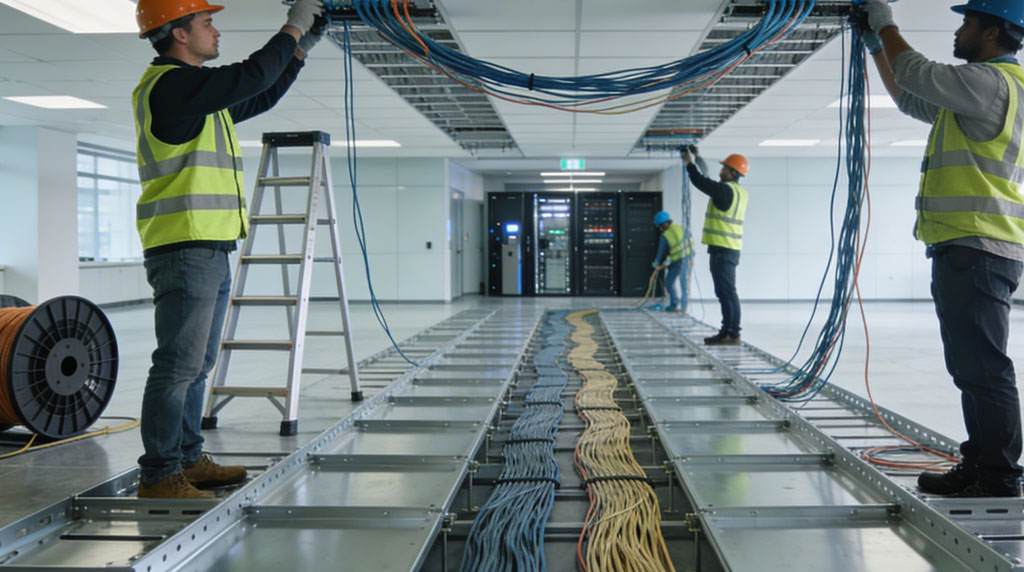
Commercial environments where coordinated low voltage planning matters most
Low voltage cabling is most valuable when a commercial project involves multiple building systems that share pathways — and when those systems need to stay operational in an active facility during installation.
Warehouses & Logistics Facilities
Warehouse low voltage projects typically involve the heaviest system mix — high-ceiling CCTV coverage across loading docks and operational zones, access control for restricted areas, wireless AP cabling for high-ceiling coverage, and network drops for admin and dispatch areas.
- Loading dock and perimeter CCTV camera cabling
- High-ceiling wireless AP drops for full-floor Wi-Fi coverage
- Access control cabling for dock doors and restricted zones
- Admin office and operational network drops
Retail & Franchise Networks
Retail low voltage projects require tight coordination between CCTV (loss prevention), access control (back room and safe room security), wireless AP coverage and POS network drops — all of which must be completed on a fast opening or remodel timeline.
- Sales floor and back-of-house CCTV coverage
- Access control for back room, storage and manager office doors
- Wireless AP cabling for customer and staff networks
- Repeatable standards across all franchise locations
Corporate Offices
Office low voltage projects typically combine network cabling with lobby and corridor CCTV, access control for secure areas and conference rooms, and wireless AP infrastructure — all sharing ceiling pathways and IDF room space that need to be planned as a unified scope.
- Lobby, corridor and parking CCTV coverage
- Access control for secure floors, server rooms and executive areas
- Conference room AV and wireless AP cabling
- Coordinated with structured cabling and MDF/IDF organization
Healthcare & Clinical Facilities
Healthcare low voltage projects require particularly careful planning — clinical spaces need secure wireless coverage, CCTV and access control for restricted areas like medication rooms and data rooms, all coordinated around ongoing patient care that cannot be disrupted during installation.
- Restricted zone access control for clinical and storage areas
- Nursing station and patient area CCTV coverage
- Wireless AP cabling for clinical device connectivity
- After-hours and phased scheduling around care operations
Hospitality & Mixed-Use
Hospitality low voltage projects coordinate guest connectivity, security, communications and back-of-house operational systems — across spaces that must remain operational for guests and staff throughout the installation period.
- Guest area and common space CCTV coverage
- Back-of-house access control and secured entry systems
- Paging and intercom infrastructure across property areas
- Wireless AP cabling for guest and staff networks
Renovations & Multi-System Upgrades
Commercial renovation projects are the ideal opportunity to upgrade all low voltage systems simultaneously — replacing legacy CCTV infrastructure, updating access control readers, upgrading network cabling to Cat6A and adding or relocating wireless AP coverage to match the new floor plan.
- Legacy CCTV system replacement and upgrade
- Access control system modernization and expansion
- Network cabling upgrade to Cat6A alongside security refresh
- New AP locations coordinated with new furniture and partition layout
Questions about commercial low voltage cabling
Answers that help facilities managers, IT leaders and operations teams understand what low voltage cabling includes and how multi-system projects are scoped and delivered.
What counts as low voltage cabling?
In commercial settings, low voltage cabling covers any cabling operating below 50 volts — including data cabling, CCTV camera cabling, access control reader and controller cabling, wireless AP cabling, AV systems, paging, intercom and other connected building systems. The term is commonly used when a project involves multiple building systems beyond basic network drops.
What is the difference between low voltage and structured cabling?
Structured cabling is an organized discipline within the broader low voltage category — it refers specifically to standardized copper and fiber infrastructure following TIA-568 standards. Low voltage is a broader term that encompasses structured cabling plus CCTV, access control, AV, paging, intercom and other connected building systems.
Can low voltage cabling include CCTV and access control?
Yes. Commercial CCTV camera cabling and access control reader/controller cabling are both core low voltage disciplines. These systems require their own pathways, conduit and termination work — and are most efficiently installed alongside network cabling when a facility is already undergoing infrastructure work.
How do low voltage systems share pathways with network cabling?
Security cameras, access control readers and wireless APs all connect back to network switches via Ethernet — so their cabling runs through the same pathway systems and terminates in the same IDF or MDF rooms as standard network cabling. Planning these runs together prevents pathway conflicts and creates a more organized finished environment.
Do you work in active facilities during low voltage upgrades?
Yes. Many low voltage projects take place in occupied offices, warehouses and retail environments. Work can be phased by zone or system, scheduled after hours, or coordinated around operational schedules to minimize disruption to ongoing business activity throughout the project.
What low voltage systems does Cablify install?
Cablify installs CCTV camera cabling, access control system cabling, wireless AP cabling, AV system cabling, paging, intercom and other connected building technology — alongside structured copper and fiber optic infrastructure, often under the same project scope for maximum coordination efficiency.
Need low voltage cabling scoped for a real commercial project?
Send the city, facility type, system mix (CCTV, access control, APs, AV), timeline and any active-site scheduling constraints — and the conversation can move toward a coordinated scope review and practical estimate.
Request a Low Voltage Quote
Tell us about your facility and the systems you need scoped — the team will review and follow up within one business day.
Facility type, city, systems needed (CCTV, access control, APs, AV), number of cameras or doors, whether the site is active during installation, and any network or structured cabling scope to coordinate alongside.
SYSTEMS: CCTV · Access control · Wireless APs · AV & paging · Network cabling